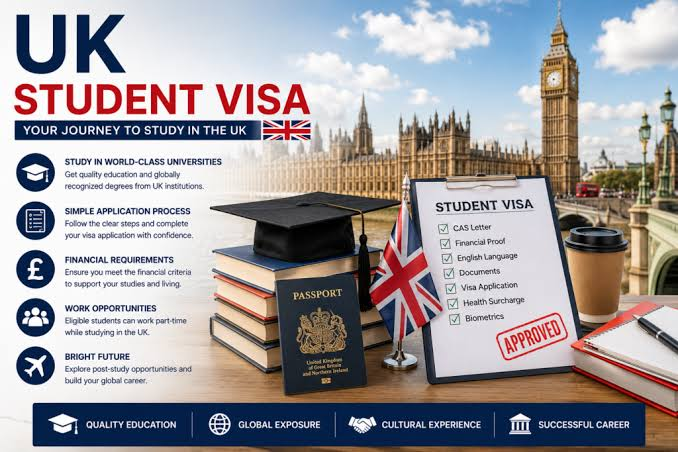

















UK Student visa
Prospective international students hoping to study in Britain must navigate a series of requirements before travelling, making proper preparation for a UK Student visa one of the most important stages of the admission process.
For many applicants, securing admission into a British university is only the beginning. Receiving an offer does not automatically give a student permission to enter the United Kingdom. Applicants must still satisfy UK immigration requirements, demonstrate that they have been accepted by an eligible education provider and, where required, prove that they have enough money to study and live in the country.
Mistakes involving financial evidence, the Confirmation of Acceptance for Studies, commonly known as CAS, supporting documents or application timing can complicate an otherwise straightforward application.
Here are 11 important steps prospective students should understand when preparing a UK Student visa application.
1. Confirm that the UK Student visa is the correct route
The first step is to establish that the UK Student visa is appropriate for the course you intend to study.
The route is generally available to people aged 16 or above who have been offered a place on an eligible course by a licensed student sponsor.
Applicants must meet the requirements applicable to their circumstances, which may include English-language, financial and parental-consent requirements.
Students under 18 intending to attend an independent school may instead need to consider the Child Student visa route.
Prospective applicants should therefore confirm the appropriate immigration category before paying fees or submitting an application.
2. Secure admission from a licensed student sponsor
An applicant ordinarily needs an unconditional offer from an education provider that is authorised to sponsor international students.
This is important because admission from an institution does not automatically mean that the institution can sponsor a student under the immigration system.
Before proceeding with a UK Student visa, applicants should therefore make sure their education provider is eligible to sponsor international students.
The institution will assess the student’s academic qualifications and other admission requirements before issuing the documentation required for the immigration process.
https://ogelenews.ng/uk-student-visa-11-steps-prospective-applicants-sho..
3. Obtain and carefully check your CAS
One of the most important documents in the process is the Confirmation of Acceptance for Studies.
The CAS is not simply an admission letter. It contains a reference number and information that connects the student’s course and education provider with the immigration application.
Applicants should carefully examine the information associated with their CAS before submitting their application.
Names, passport information, course details, tuition fees and payments already made should be checked for accuracy.
Where there is a discrepancy, the applicant should contact the education provider rather than knowingly submitting incorrect information.
4. Calculate the money you need
Financial preparation is one of the areas where applicants must exercise particular care.
A student may need to demonstrate sufficient funds to cover outstanding course fees shown on the CAS as well as the required living expenses.
The amount required for maintenance depends partly on whether the institution is in London or outside London.
Applicants should use the figures applicable on the date of their application rather than relying on an old social-media post, previous applicant or outdated online article.
This is particularly important because immigration financial requirements can change.
5. Observe the financial evidence rules
Having money is not always enough. Where financial evidence is required, the money must also satisfy the immigration rules.
Depending on the applicant’s circumstances, acceptable evidence can include personal funds, qualifying parental funds, an eligible student loan or official financial sponsorship.
Where personal or qualifying family funds are being relied upon, applicants should pay close attention to how long the required amount must remain available and how recent the supporting evidence must be.
A sudden deposit followed by an immediate application can create problems if it fails to satisfy the required holding period.
Students using a parent’s funds should also ensure they provide the required evidence showing their relationship and permission to use those funds.
This is one of the areas of a UK Student visa application where careful preparation matters more than assumptions.
6. Prepare the required documents
Applicants should assemble their supporting documents before completing the process.
A valid passport or other accepted travel document and the CAS are fundamental requirements.
Depending on individual circumstances, other documents may be necessary.
These can include financial evidence, evidence of parental or legal guardian consent for applicants under 18, proof of relationship to a parent or guardian, a tuberculosis test certificate, and an Academic Technology Approval Scheme certificate for certain courses.
Documents not in English or Welsh may also require appropriate translations.
The key lesson is simple: applicants should prepare according to their own circumstances rather than copying another student’s document list.
7. Check whether you need a tuberculosis test or ATAS certificate
Some international students need additional clearance before completing their UK Student visa application.
Applicants who meet the UK’s tuberculosis-testing conditions must obtain the required certificate from an approved clinic.
Students studying certain sensitive subjects at postgraduate level may also require an Academic Technology Approval Scheme certificate before applying.
ATAS requirements should be checked early because waiting until the last stage could affect an applicant’s timetable.
The same principle applies to tuberculosis testing. Applicants should use clinics recognised by the UK authorities where the requirement applies.
8. Complete the online application accurately
Applicants applying from outside the United Kingdom can generally submit their application up to six months before their course starts.
The online form should be completed carefully and consistently with the applicant’s passport, CAS and supporting documents.
Previous immigration history, personal information and other questions should be answered truthfully.
An innocent error can sometimes be corrected, but false information or deliberate concealment can have far more serious consequences.
Applicants should therefore review every important entry before submitting their UK Student visa application.
9. Pay the visa fee and Immigration Health Surcharge
The application process involves more than tuition fees.
Applicants must pay the applicable UK Student visa application fee and will generally also need to pay the Immigration Health Surcharge.
The health surcharge contributes towards access to Britain’s National Health Service during the period covered by the immigration permission, although some NHS services may still attract separate charges.
Applicants should therefore budget for the visa application, healthcare surcharge, tuition-related payments and other relocation costs rather than focusing exclusively on school fees.
These expenses can be substantial and should be considered before the application begins.
10. Prove your identity and complete the required process
After applying, students must follow the instructions provided for proving their identity.
The precise process can depend on the applicant’s circumstances and the system they are directed to use.
Some applicants may need to attend a visa application centre, while eligible applicants may be instructed to use the UK’s digital identity process.
Where an appointment is required, students should attend with the necessary documentation and follow the instructions issued during the application.
Applicants should also monitor their email carefully after submission because immigration authorities may request additional information.
Ignoring such communication can unnecessarily complicate the application.
11. Check your decision, eVisa and travel dates before departure
A successful decision is not the end of the process.
Successful applicants should carefully check the immigration permission they have been granted and ensure that their travel document is properly linked to their UKVI account where required.
The United Kingdom now uses eVisas as digital records of immigration status.
Students should also check when they are legally permitted to enter Britain.
For courses lasting more than six months, students can generally arrive up to one month before the course begins. For courses lasting six months or less, arrival can generally be up to one week before the course begins.
However, a student must not enter before the date permitted by the visa.
Applicants should also pay close attention to any latest enrolment or arrival deadline imposed by their university.
Students should avoid last-minute applications
Perhaps the biggest practical lesson for prospective students is to begin early.
Applicants outside the United Kingdom can normally apply for a UK Student visa as early as six months before the beginning of their course.
UK authorities say applicants applying from outside the country will usually receive a decision within three weeks, although individual cases can take longer.
Faster processing may be available to some applicants for an additional fee, but applicants should not build their entire travel plan around obtaining an expedited decision.
Applying early creates room to address unexpected requests, documentation problems or other delays.
Financial requirements deserve particular attention
Prospective students should also remember that financial requirements are not static.
For applications under the current rules, students studying in London may need to demonstrate £1,529 for each month of their course, up to nine months, while those studying outside London may need £1,171 per month for the same maximum period.
That means the maximum maintenance calculation can reach £13,761 for London and £10,539 outside London, excluding any outstanding tuition fees that must also be demonstrated.
Where the 28-day holding requirement applies, applicants must ensure the qualifying funds remain available for the required consecutive period.
This is why students should check current official guidance before moving money or generating bank statements.
Preparation remains the safest approach
Thousands of international students travel to Britain each year to pursue undergraduate and postgraduate education, but admission and immigration remain separate processes.
An offer from a university should therefore be treated as the beginning of the immigration preparation rather than its conclusion.
Students should confirm their CAS information, understand the financial requirements, obtain necessary certificates, submit accurate information and monitor communication after applying.
Most importantly, prospective applicants should rely on current official immigration guidance rather than rumours circulating on WhatsApp, TikTok, Facebook or informal student forums.
The UK Student visa process is manageable when applicants understand the rules and prepare carefully.
Immigration requirements can change, however, so every prospective student should verify the requirements applicable on the actual date of application.
For applicants preparing for the next academic intake, the safest approach is straightforward: secure admission early, obtain the CAS, organise qualifying funds well ahead of time, prepare the correct supporting evidence and submit the application without waiting until the university’s arrival deadline is dangerously close.
https://www.gov.uk/tb-test-visa?utm_source=chatgpt.com