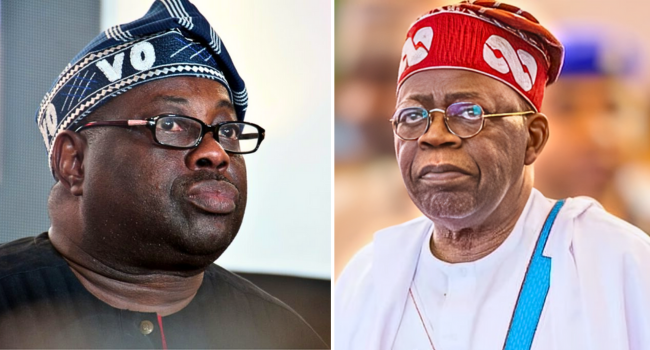

















Dele Momodu Tinubu criticism
ABUJA, Nigeria — Veteran journalist and African Democratic Congress chieftain Dele Momodu has said he would be prepared to strongly support President Bola Tinubu if the administration returned to the democratic ideals both men defended during Nigeria’s struggle against military rule.
Momodu said his continuing criticism of the President was not driven by personal hostility but by concerns over governance, democratic freedom and what he described as the danger of replacing military dictatorship with civilian authoritarianism.
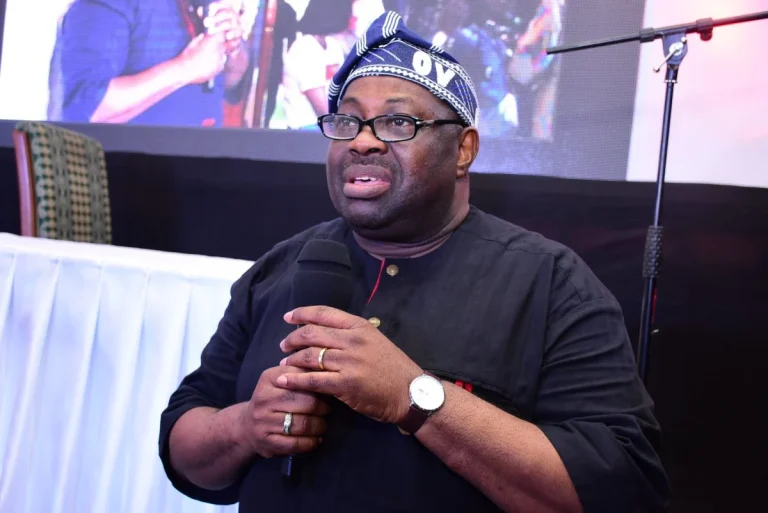
The latest Dele Momodu Tinubu criticism came during an interview on ARISE Television, where the Ovation Magazine publisher reflected on his decades-long relationship with Tinubu and their shared involvement in Nigeria’s pro-democracy struggle.
Using characteristically dramatic language, Momodu said he would be willing to “swim to the depth of the Atlantic Ocean” for Tinubu if the President practised the democratic principles they fought to establish during years of military dictatorship.
But he said supporting the President uncritically under current circumstances would make him a hypocrite.
His remarks present a more complicated picture of the relationship between the two men than the increasingly adversarial political exchanges surrounding the 2027 presidential election might suggest.
Dele Momodu Tinubu Criticism Is Not Personal, Publisher Says
Momodu said he retains tremendous respect for Tinubu despite their current political differences.
He recalled that the President was one of the political figures who helped shape his own understanding of political resistance and gave him confidence that entrenched power could be challenged.
According to Momodu, Tinubu demonstrated during his political development that establishment forces could be confronted and defeated.
That history explains why the latest Dele Momodu Tinubu criticism carries a distinctly personal dimension.
The two men are not strangers who first encountered each other through contemporary party politics.
Their relationship dates back more than three decades to the struggle surrounding the annulment of the June 12, 1993 presidential election and the campaign to end military rule in Nigeria.
Momodu’s argument is that the principles associated with that struggle should still guide political leadership today.
June 12 Struggle Connects Tinubu and Momodu
Tinubu was a senator during the aborted Third Republic and later became a prominent member of the National Democratic Coalition, NADECO.
The coalition emerged following the annulment of the June 12 election widely believed to have been won by businessman and politician Moshood Kashimawo Olawale Abiola.
NADECO became one of the most prominent platforms demanding restoration of democratic rule and recognition of the June 12 mandate.
Tinubu eventually went into exile in 1994 as the military government of General Sani Abacha intensified its crackdown on opposition figures.
Momodu was also active in the pro-democracy campaign.
He had worked around Abiola’s presidential campaign and later faced detention because of his involvement in the June 12 struggle.
Like Tinubu, he eventually left Nigeria during the Abacha era and spent time in exile.
That shared history forms the backdrop to the current Dele Momodu Tinubu criticism.
Momodu’s position is essentially that those who opposed authoritarian rule decades ago should not tolerate similar tendencies simply because civilians now occupy political office.
Momodu Warns Against ‘Civilian Dictatorship’
The most serious part of Momodu’s remarks concerns what he sees as the health of Nigeria’s democracy.
He argued that there would have been little purpose in struggling against military dictatorship if democratic government eventually reproduced similar patterns of intolerance and excessive concentration of power.
For Momodu, that is the central issue behind his disagreement with Tinubu.
The Dele Momodu Tinubu criticism therefore extends beyond economic policy or the personalities involved in the 2027 election.
It touches on opposition politics, institutional independence, freedom of political participation and the willingness of those in power to tolerate dissent.
Momodu has repeatedly accused the ruling All Progressives Congress of weakening opposition politics and has spoken publicly about concerns over the judiciary, electoral institutions and Nigeria’s democratic environment.
Those claims remain his political assessment, but they have become a consistent theme in his commentary.
Momodu Says He Does Not Abuse Tinubu
Despite his strong language, Momodu said he deliberately avoids personal insults against the President.
He distinguished criticism of government from abuse of Tinubu as an individual.
According to him, even when other critics attack the President personally, he generally refuses to join them because of the respect he retains for Tinubu and the role the President played in his political development.
That distinction is important to understanding the Dele Momodu Tinubu criticism.
Momodu is now firmly aligned with opposition politics, but he is simultaneously acknowledging a personal and historical debt to the President.
In Nigeria’s often confrontational political culture, that is relatively unusual.
Political disagreement frequently develops into personal hostility.
Momodu is arguing that the two do not have to be the same.
2027 Election Looms Over Political Exchange
The timing of the remarks is also significant.
Nigeria is entering the full political season for the 2027 general election.
Tinubu is seeking another term, while opposition parties are attempting to build electoral coalitions capable of defeating the ruling APC.
Momodu is currently associated with the African Democratic Congress and has become one of the prominent public voices supporting the opposition ahead of the election.
He has previously argued that the performance of the Tinubu administration should be the central issue in the presidential campaign.
Earlier this month, Momodu challenged the President to present his administration’s scorecard rather than relying on political attacks against opponents.
He said Tinubu could make the 2027 contest easier for himself if he demonstrated convincingly that his government had improved the lives of Nigerians.
That argument is consistent with the latest Dele Momodu Tinubu criticism.
His position is that the President should be judged on governance rather than personal relationships.
Momodu Previously Said Tinubu Could Be Defeated
Momodu has also made increasingly confident predictions about the 2027 presidential election.
In June, he argued that former Vice President Atiku Abubakar could defeat both Tinubu and Peter Obi if Atiku secured a commanding share of northern votes while remaining competitive in southern Nigeria.
That prediction reflects Momodu’s current political alignment.
He has become a strong advocate for the opposition’s chances and has repeatedly challenged the assumption that incumbency automatically guarantees Tinubu another term.
The Dele Momodu Tinubu criticism must therefore also be understood within an election environment.
Momodu is not commenting as a politically neutral observer.
He is an opposition figure participating in the national debate over whether Tinubu deserves another four years in office.
That makes attribution especially important.
His assessments should be reported as political arguments, not established conclusions.
https://ogelenews.ng/momodu-says-he-would-back-tinubu-if-president-uphol…
Performance, Not Friendship, Should Decide Support
One of the strongest themes in Momodu’s current position is that historical friendship should not determine political loyalty.
The publisher has said he would support Tinubu if the President governed according to principles he considered consistent with their earlier democratic struggles.
But he does not believe that personal loyalty should prevent criticism.
This position carries a wider implication for Nigerian politics.
Political relationships often survive across decades.
Politicians who appear to be bitter opponents today may previously have belonged to the same parties, coalitions or ideological movements.
Momodu and Tinubu are an example.
Their political paths have diverged significantly, but the history remains.
The latest Dele Momodu Tinubu criticism shows how those relationships can produce complicated public positions.
Momodu can praise Tinubu’s political courage while criticising his administration.
He can acknowledge personal respect while supporting an opposition candidate.
And he can remember their shared democratic struggle while arguing that the government has departed from its principles.
Tinubu’s Supporters Will Reject Momodu’s Assessment
Supporters of the President are unlikely to accept Momodu’s description of the administration.
The APC has consistently defended Tinubu’s democratic credentials and argued that the President remains committed to constitutional government, electoral competition and political freedom.
Government supporters also point to elections won by opposition parties as evidence that Nigeria remains politically competitive.
The recent Osun governorship election, for example, ended with opposition Governor Ademola Adeleke securing re-election.
Tinubu subsequently met Adeleke and urged him to govern magnanimously.
Supporters of the President are likely to cite developments such as these against suggestions that opposition politics has been extinguished.
The debate surrounding Dele Momodu Tinubu criticism is therefore fundamentally contested.
Momodu sees warning signs.
Tinubu’s supporters see a functioning democracy in which political competition continues.
The strength of either argument should ultimately be judged against institutional behaviour rather than political rhetoric.
Democracy Must Be Tested by Institutions
The real test is not whether politicians describe Nigeria as democratic.
It is whether institutions function democratically.
Can opposition parties organise freely?
Can journalists criticise government without intimidation?
Can courts decide politically sensitive cases independently?
Can electoral authorities operate without interference?
Can citizens protest peacefully?
Can ruling-party candidates lose elections without state institutions being used to reverse those outcomes?
Those questions are more meaningful than slogans.
They also explain why the Dele Momodu Tinubu criticism should be treated as more than another personal exchange between two veteran political figures.
It is part of a broader debate about what democratic government should look like nearly three decades after the end of military rule.
Ogele News Analysis: The Atlantic Line Is the Hook, Democracy Is the Story
The original headline, “I’ll swim Atlantic for Tinubu if he practises what we fought for — Momodu,” is memorable and highly clickable.
But it risks creating the impression that Momodu is moving towards endorsing Tinubu.
That is not what he said.
His statement was explicitly conditional.
The stronger story is that an opposition figure who has known Tinubu for decades says he still respects the President personally but believes the administration has departed from principles associated with their shared pro-democracy past.
That is where the journalism lies.
The Atlantic Ocean metaphor is the hook.
The substance is democracy.
Momodu’s position should also be subjected to scrutiny.
Opposition politicians naturally have incentives to portray incumbent governments negatively.
His characterisation of the administration as moving towards civilian dictatorship is therefore a political judgement, not an established institutional finding.
But government supporters should equally resist treating every criticism as personal hostility.
Nigeria’s democratic history was built partly by people who insisted on the right to challenge those in authority.
That principle does not disappear when former activists become officeholders.
The Dele Momodu Tinubu criticism therefore raises a useful question ahead of 2027.
Should political loyalty be based on friendship, history and party affiliation, or on current performance and adherence to democratic principles?
Momodu has answered that question for himself.
He says personal respect for Tinubu remains.
Political support does not.
At least not under present circumstances.
For him to metaphorically “swim the Atlantic” for the President, Momodu says Tinubu would first have to demonstrate the democratic values that both men once risked exile and persecution to defend.
Whether voters share that assessment is something the 2027 election will eventually determine.