
















FCT police extortion trial
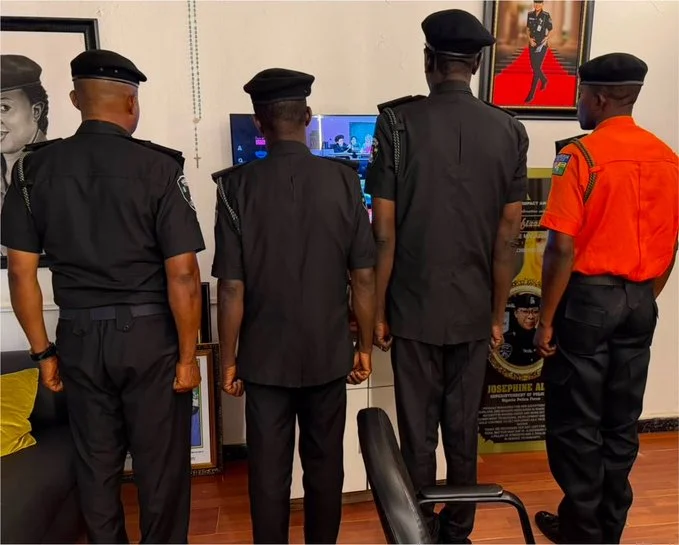
The Federal Capital Territory Police Command has commenced disciplinary proceedings against four officers accused of abandoning their assigned duty posts, conducting an unauthorised traffic operation and extorting ₦52,000 from the Chairman of the Independent Corrupt Practices and Other Related Offences Commission, Dr Musa Adamu Aliyu, SAN.
The Commissioner of Police in the FCT, Ahmed Muhammed Sanusi, ordered the immediate arrest and orderly room trial of the officers after the command received a complaint about the July 11, 2026 incident.
The officers were identified as Assistant Superintendent of Police Clement Ehigala, Assistant Superintendent of Police Sunday Okpe, Inspector Samuel Onoja and Sergeant Yakubu Emmanuel.
According to the FCT Police Command, the officers allegedly left their lawful duty posts and assembled at Banex Plaza Junction in Wuse II, Abuja, where they carried out traffic enforcement without authorisation.
During the operation, they reportedly stopped a motorist over an alleged traffic violation and collected money from him without knowing that he was the ICPC chairman.
The FCT police extortion trial has consequently become a major test of the command’s declared zero-tolerance policy on corruption, abuse of authority and unprofessional conduct.
Although the identity of the victim has attracted national attention, the disciplinary process must establish the allegations through evidence and determine the appropriate sanctions under police regulations.
Officers allegedly abandoned duty posts
FCT Police Public Relations Officer SP Josephine Adeh said the incident occurred at about 3:34 p.m. on July 11.
The four officers allegedly left the locations where they had been officially deployed and proceeded to Banex Plaza Junction, where they began enforcing traffic rules without approval.
This aspect of the allegation is significant.
Police personnel are deployed through an established command structure. Officers who abandon their assigned locations and create an unofficial checkpoint undermine operational control and expose road users to possible abuse.
The FCT police extortion trial is therefore not limited to the allegation that money was collected from a motorist.
The officers are also facing questions over abandonment of duty and participation in an unauthorised traffic operation.
Investigators should establish who proposed the operation, how the officers communicated with one another and whether the Banex Junction incident was the first time they had carried out such an activity.
If evidence shows that the group had conducted similar operations previously, the command should identify other possible victims and invite them to submit complaints.
ICPC chairman stopped as ordinary motorist
The officers reportedly stopped Aliyu without initially recognising him as the head of Nigeria’s anti-corruption commission.
That detail makes the incident particularly revealing.
Had the motorist been immediately recognised as a senior public official, the alleged demand might never have occurred. The officers’ reported ignorance of his identity raises the possibility that an ordinary resident could have faced similar treatment without possessing the influence required to obtain a swift response.
The FCT police extortion trial should therefore not be celebrated merely because an important government official received justice.
It should produce reforms protecting every road user, regardless of status, occupation or political connection.
Police accountability cannot operate only when a victim is influential.
A trader, commercial driver, student, civil servant or visitor stopped on an Abuja road should enjoy the same legal protection available to the chairman of an anti-corruption agency.
The command must demonstrate that complaints from less powerful residents will also be investigated quickly and impartially.
Discrepancy over alleged amount
Initial reports quoted the police commissioner as saying the officers extorted ₦53,000 from the ICPC chairman.
Sanusi said the victim was taken to a Point of Sale operator, where he withdrew the money, paid the associated transaction charge and watched as the officers allegedly shared the funds.
However, the command’s subsequent detailed statement said the officers collected ₦52,000.
The apparent difference may relate to the Point of Sale transaction charge, although the police have not publicly provided a complete financial breakdown.
For accuracy, the FCT police extortion trial should be reported using the ₦52,000 figure contained in the command’s formal statement, while noting that the commissioner earlier referred to ₦53,000.
Investigators should obtain the Point of Sale records, bank debit alert and any available surveillance footage.
Electronic transaction evidence can establish the amount withdrawn, the location of the withdrawal and the exact time of the transaction.
The Point of Sale operator may also provide witness testimony about who accompanied the victim and what occurred during the withdrawal.
Commissioner promises severe sanctions
Sanusi described the alleged conduct as disgraceful and promised that officers found culpable would face serious punishment.
He said those whose offences justified dismissal would be dismissed from the police force.
Such a statement reflects the seriousness of the accusations, but punishment must follow a fair and properly documented disciplinary process.
The four officers remain accused persons until the orderly room trial determines the allegations against them.
The FCT police extortion trial should allow them to hear the charges, review the evidence, respond to witnesses and present any defence available under police regulations.
Due process is not an obstacle to accountability. It gives disciplinary decisions greater legitimacy and reduces the likelihood that sanctions will later be overturned for procedural defects.
The command should also avoid prejudging the outcome through public statements.
Senior police officials may condemn extortion generally while allowing the panel to determine the individual responsibility of each accused officer.
What an orderly room trial means
An orderly room trial is an internal police disciplinary proceeding used to investigate alleged violations of service regulations.
It is different from a criminal trial before a regular court.
Depending on the ranks involved and the offences established, disciplinary sanctions may include reprimand, reduction in rank, suspension or dismissal.
However, an internal proceeding should not prevent criminal investigation where the evidence reveals conduct prohibited by Nigerian law.
If the FCT police extortion trial establishes that officers unlawfully demanded and received money through intimidation or abuse of their official authority, the matter should be reviewed for possible prosecution.
Removing an officer from service may protect the institution, but dismissal alone may be insufficient where the conduct also amounts to a criminal offence.
The police should therefore explain whether a separate investigation file will be forwarded to the appropriate prosecuting authority after the disciplinary hearing.
The ICPC may also have jurisdiction to examine alleged corrupt conduct involving public officers, although any institutional role should be managed carefully because its chairman was the reported victim.
No officer has power to create a checkpoint
The allegation that the officers established an unauthorised enforcement point goes to the heart of police command and control.
Checkpoints and traffic operations should be formally approved, properly supervised and connected to legitimate security objectives.
Officers cannot lawfully leave their assigned posts, assemble independently and begin demanding compliance from motorists under the appearance of official authority.
Such operations create opportunities for extortion, unlawful searches and intimidation.
The FCT police extortion trial should determine whether supervisors noticed the officers’ absence and whether deployment records showed where each officer was expected to be at the time.
Commanders must be able to account for personnel under their control.
Digital duty registers, body-worn cameras and location-monitoring systems could help supervisors identify officers who abandon assigned locations.
Where technology is unavailable, regular radio checks and unannounced supervisory visits can strengthen accountability.
https://ogelenews.ng/fct-police-extortion-trial
Alleged Point of Sale withdrawal raises alarm
The reported use of a Point of Sale operator reflects a pattern frequently described in allegations of roadside extortion.
As Nigeria moves towards electronic transactions, corrupt demands no longer depend solely on cash already carried by a victim.
A motorist can be directed to a nearby agent, compelled to transfer money or made to withdraw funds under pressure.
This makes financial records an important investigative tool.
The FCT police extortion trial should examine whether the withdrawal was voluntary, whether threats were made and whether any officer physically accompanied the ICPC chairman to the operator.
Investigators should also determine how the money was allegedly divided.
Where electronic transfers were used, the destination accounts should be identified. Where cash was collected, witness testimony and surrounding video evidence may help reconstruct events.
Point of Sale operators should not knowingly assist extortion, but they may also be unaware that a customer is acting under coercion.
Police commands should work with financial institutions to develop rapid procedures for preserving transaction evidence when extortion is reported.
Phone searches remain a concern
During his briefing, Sanusi also warned officers against indiscriminate searches of citizens’ mobile phones.
He said police personnel on patrol had no authority to stop motorists arbitrarily and demand access to their devices.
The commissioner encouraged residents confronted with such demands to refuse and contact police emergency channels.
This warning is relevant because unauthorised phone searches are frequently associated with extortion complaints.
Officers may accuse young people of internet fraud based on their appearance, inspect banking applications or private conversations and then demand payment to release them.
The FCT police extortion trial should therefore become part of a broader campaign against unlawful roadside practices.
A mobile phone contains deeply personal information, including messages, photographs, financial records, health information and professional documents.
Access should not be demanded casually.
Where investigators reasonably suspect that a device contains evidence of an offence, they should follow lawful procedures rather than use roadside intimidation.
Public confidence depends on transparency
The speed with which the command arrested the officers is encouraging, but public confidence will depend on the conclusion of the process.
Police authorities often announce investigations into alleged misconduct. Far fewer cases receive equally prominent updates explaining the findings and sanctions imposed.
The FCT command should publish the outcome of the FCT police extortion trial once proceedings are completed, subject to lawful restrictions.
The public should be told whether each charge was proved, what evidence was considered and what disciplinary action followed.
If any officer is cleared, the command should say so clearly.
If officers are demoted, suspended or dismissed, the decision should also be made public.
Transparency protects both citizens and innocent officers. It prevents rumours while demonstrating that disciplinary proceedings are not merely public-relations responses designed to calm outrage.
Sanctions must go beyond dismissal
Where misconduct is established, the command should consider the institutional conditions that allowed it to occur.
The four officers allegedly came from different duty locations, assembled together and operated without authorisation.
That suggests possible weaknesses in supervision.
The FCT police extortion trial should therefore examine the responsibility of immediate supervisors who may have failed to notice that officers were absent.
This does not mean supervisors should automatically be punished for every wrongdoing by their subordinates.
It means the command should determine whether required checks were carried out and whether any warning signs were ignored.
Police reform cannot succeed through the repeated dismissal of individual officers alone.
Recruitment standards, welfare, training, supervision, deployment procedures and complaint mechanisms must all improve.
Officers must be paid and equipped adequately, but poor welfare can never justify extortion or abuse of citizens.
Complaint channels must work for everyone
The case demonstrates the value of reporting misconduct, but many residents do not know where or how to complain.
Others fear retaliation, disbelief or endless administrative delays.
The FCT Police Command should maintain accessible telephone numbers, messaging platforms and physical complaint desks.
Every complaint should receive a reference number that allows the victim to follow its progress.
The FCT police extortion trial should also encourage the command to strengthen protections for complainants.
Victims should not be required to confront accused officers informally or return repeatedly to the same division where the alleged misconduct occurred.
Evidence such as debit alerts, photographs, audio recordings and vehicle details should be accepted through secure channels.
Police officers who threaten complainants or pressure them to withdraw reports should face separate disciplinary action.
ICPC’s position adds symbolic importance
The alleged victim leads the federal institution responsible for investigating and preventing corrupt practices in public service.
That gives the incident considerable symbolic weight.
An agency chairman entrusted with fighting corruption reportedly became the target of the same type of abuse that ordinary citizens frequently accuse public officials of committing.
The FCT police extortion trial therefore illustrates the persistence of corruption risks within law-enforcement operations.
Aliyu’s status may help draw attention to a problem already familiar to many motorists, but the response should extend beyond this single incident.
The ICPC and police could use the case to strengthen cooperation on preventing petty corruption, protecting whistle-blowers and educating officers about the legal consequences of demanding unofficial payments.
Any collaboration must, however, preserve the fairness of the ongoing disciplinary proceedings.
Authorities must protect presumption of innocence
Public outrage should not replace evidence.
The police statement describes the officers as accused of misconduct, and the orderly room trial has been established to determine culpability.
News organisations must use words such as “allegedly,” “accused” and “reportedly” until a competent disciplinary or judicial authority reaches a conclusion.
The FCT police extortion trial should not become a media conviction driven by the victim’s position.
Each officer’s conduct must be considered individually.
One officer may have initiated the demand, another may have participated actively, while another could dispute knowledge of the alleged collection.
The evidence must establish the role of each person rather than treating group presence as automatic proof of identical responsibility.
Fairness to accused officers strengthens rather than weakens the campaign against police corruption.
A test of the FCT command’s credibility
Commissioner Sanusi has promised severe sanctions and described the alleged conduct as incompatible with police service.
The credibility of that promise will be measured by the thoroughness and transparency of the final outcome.
The FCT police extortion trial gives the command an opportunity to demonstrate that rank does not provide immunity from accountability.
Two of the accused officers hold the rank of assistant superintendent, while the others are an inspector and a sergeant.
Their different ranks should not influence the evidential standard or shield senior personnel from appropriate sanctions.
The command must also determine whether any proceeds can be recovered and returned to the complainant.
If Point of Sale charges formed part of the loss, those should be documented accurately.
Justice must reach ordinary motorists
The incident should lead to a broader review of unofficial traffic operations across Abuja.
Police supervisors should identify locations where officers regularly stop motorists without clearly marked patrol vehicles, approved checkpoints or visible command authorisation.
Residents should be educated on the information they may reasonably request from officers and the safest way to report suspected misconduct.
The FCT police extortion trial will achieve limited value if it punishes four officers while similar practices continue elsewhere.
Abuja residents must see that the same urgency shown in the ICPC chairman’s case will apply when an unknown citizen reports extortion.
Justice must not depend on discovering that the motorist in an ordinary vehicle is a senior government official.
Every person stopped by the police is entitled to dignity, lawful treatment and protection from demands for unofficial payment.
The orderly room trial is an important first step.
Its true significance will be determined by the evidence produced, the fairness of the proceedings, the sanctions imposed where guilt is established and the reforms adopted to prevent another unauthorised police team from operating on the streets of the Federal Capital Territory.
https://www.thecable.ng/four-police-officers-arrested-for-extorting-n53k-from-icpc-chairman-in-abuja